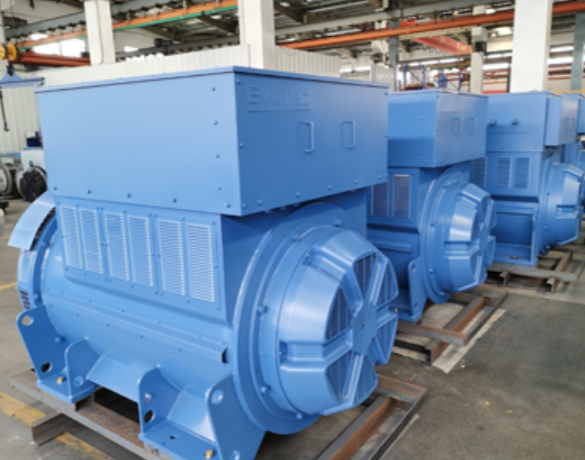
Comparative lead: performance trade-offs and use-case clarity
Selecting a certified marine alternator for an industrial power plant requires direct comparison across electrical, mechanical and control domains. Begin by matching continuous kVA capability, transient response and enclosure class — for example, an application that lists a 4 pole generator will demand different cooling and transient handling than a high-speed alternative. This comparative approach reduces specification drift and aligns procurement with operational duty cycles and site constraints.
Electrical benchmarks: voltage, frequency, and excitation
Specify voltage regulation as ±0.5% steady-state and frequency stability within ±0.25 Hz under rated load for island-mode operation. Require detailed automatic voltage regulator (AVR) curves and excitation system response times (rise time, damping ratio) rather than generic statements. Include harmonic distortion limits — total harmonic distortion (THD) under 5% at rated linear load — to protect downstream switchgear and sensitive instrumentation. Real-world anchor: a 3500 kVA generator installed at the Port of Rotterdam demonstrated that tight AVR tuning and robust excitation eliminated voltage sag during container-crane startups; use that operational precedent when validating vendor test reports. Use synchronous machine parameters (direct-axis reactance, transient reactance) supplied from factory tests for model-based stability studies.
Mechanical and environmental criteria
Demand mechanical specifications that map to the site: permissible vibration spectra, baseplate natural frequencies, and shock tolerance for marine-adjacent installations. Define cooling performance: forced-air or liquid cooling curves tied to ambient temperature and altitude derating. Specify enclosure ratings explicitly (for example, IP66 with defined salt-spray exposure cycles: 48-hour neutral salt spray per ISO 9227 and post-test corrosion depth limits). Also require bearing life projections and maintenance intervals. Avoid vague phrases — state torque limits, allowable shaft misalignment, and insulation class thermal limits. Small caveat — supplier datasheets sometimes omit actual test-cycle parameters; insist on witnessing or certified test reports.
Control, protection and system integration
Paralleling capability is non-negotiable for multi-unit plants: require digital governors with load-sharing accuracy within ±3% and active load-transfer logic for island-to-grid transition. Specify protection relay settings (overcurrent trip curves, reverse power protection, under/over-frequency thresholds) with coordination diagrams. Include communications: modbus/TCP or IEC 61850 profiles and sampling rates for supervisory systems. Define black-start sequences and grid-following behavior with measured response times. Integration tests must include fault injection and simulated grid disturbances to verify protective coordination and control authority.
Common specification errors and practical alternatives
Typical mistakes include relying solely on rated kVA without considering transient MVA for motor starts, accepting generic IP ratings without corrosion-cycle metrics, and omitting measured AVR step-response. Remedies: require factory acceptance tests with load banks, validated noise and insulation tests, and a written spare-parts list tied to lead times. When weight, footprint or cooling make a large alternator impractical, compare compact high-speed alternators or multiple smaller units with explicit load-sharing logic. When evaluating suppliers, compare {main_keyword} performance data against {variation_keyword} metrics to ensure apples-to-apples assessment.
Three golden rules for final selection
1) Verify dynamic performance with vendor-supplied time-domain test traces: voltage recovery after 100% step-load and AVR response within specified milliseconds. 2) Insist on end-to-end integration tests that include protection coordination, communications, and simulated fault conditions; measurable pass/fail criteria must be defined. 3) Require lifecycle data: MTBF estimates, scheduled maintenance intervals, and local spares availability with maximum lead times. These metrics convert specification into operational certainty.
Final thought — specify suppliers who deliver measurable test evidence and local service competence; that aligns specification to sustained plant availability. — EvoTec.