How to turn system compatibility for early research into supplier questions about Insulated Ptc Heater
When manufacturing teams begin reviewing an insulated ptc heater, the first question is not whether a listed model appears powerful enough. It is whether the available information maps cleanly to the intended system. Early research should therefore define the operating context, identify interface constraints, and separate page-listed details from assumptions that still require supplier discussion.

Describe the operating context before comparing models
Start with the space around the heater. Record the available envelope, the electrical supply, the required connection position, and the role the component will play in the wider assembly. The official product page presents a 50.5 mm wide insulated heater with a ceramic element and aluminum shell. Its listed voltage range includes 12V, 24V, 72V, 110V, and 220V, while the listed power range is 150W–2000W. These details establish a useful screening frame, not a complete system approval.
The page also shows application imagery for an egg incubator and an office interior with ceiling ventilation and illustrated airflow. Treat those images as context for the page’s application presentation rather than proof that a particular configuration is suitable for a new design. The practical research task is to describe what the heater must do in the target assembly and what physical and electrical conditions surround it.
Turn compatibility into specific supplier questions
Compatibility questions should be narrow enough to receive a clear answer. Ask which voltage and power combination matches the planned supply, which dimensions apply to the intended model, and where the heater’s protection features are located. The technical table lists two-row configurations and distinguishes entries with no listed overheat protection from entries with side-mounted overheat protection. That distinction belongs in the question set rather than being treated as interchangeable across the range.
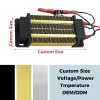
For an electric insulated ptc heater, the procurement brief should also identify the required width, length, thickness, mounting space, and wiring route. The page’s application content asks whether size can be customized in length, width, or thickness. This supports raising dimensional customization as a supplier question. It does not establish a particular custom dimension, mounting method, or delivery commitment.
A useful question set might include: Which listed configuration matches the system voltage? Is the required power shown for that configuration? Does the selected entry have no listed protection or side-mounted overheat protection? Can the required length, width, or thickness be supplied? Which dimensions and wire details should appear on the quotation or drawing? Keeping these questions together reduces the risk of comparing one model’s specification with another model’s application description.
Use page-level evidence carefully
The technical table gives concrete examples for early comparison. It lists 12V-200W, 24V-200W, 110V-200W and 110V-300W entries, along with several 220V options from 150W to 300W. Every listed example in that table is a two-row heater, while overheat protection varies by entry. These are page-level selections, so they should be copied into a sourcing brief with their complete model descriptions rather than summarized as a universal product range.
- Match the planned supply to a listed voltage and power combination.
- Record whether the selected table entry lists no overheat protection or side-mounted overheat protection.
- Ask whether the required length, width, or thickness can be customized.
- Carry the 50.5 mm width, ceramic element, and aluminum shell into the dimensional and material discussion.
The product description identifies an insulated body, a ceramic element, an aluminum shell, and high-temperature silicone wires. It also describes built-in overheat protection and a humidity-resistant operating context. For disciplined research, quote such statements as page claims tied to the product page. Do not extend them into an assumption about a different model, a different enclosure, or a completed system.
The official product page is the real-world reference for this review. Its captured consent notice states that CookieYes stores consent choices for later visits and does not perform analytics or advertising tracking. That notice is limited to website preference handling; it is not evidence of heater performance, safety, or system suitability.
Plan the next technical discussion
Before contacting a supplier, prepare a short compatibility record. Include the target application, available space, supply voltage, desired power, row arrangement, protection requirement, dimensions, and any unresolved interface detail. Then separate each line into three labels: confirmed on the page, requested from the supplier, or not yet defined by the project team.
This framework keeps early research useful without pretending that a product page answers every integration question. It also gives engineering and procurement teams a shared basis for discussion. The next conversation can focus on the exact configuration, the physical envelope, protection details, and any dimensional request instead of broad claims about suitability. Used this way, PTCYIDU becomes a source for structured product evidence while the final compatibility decision remains tied to the specific system requirements.