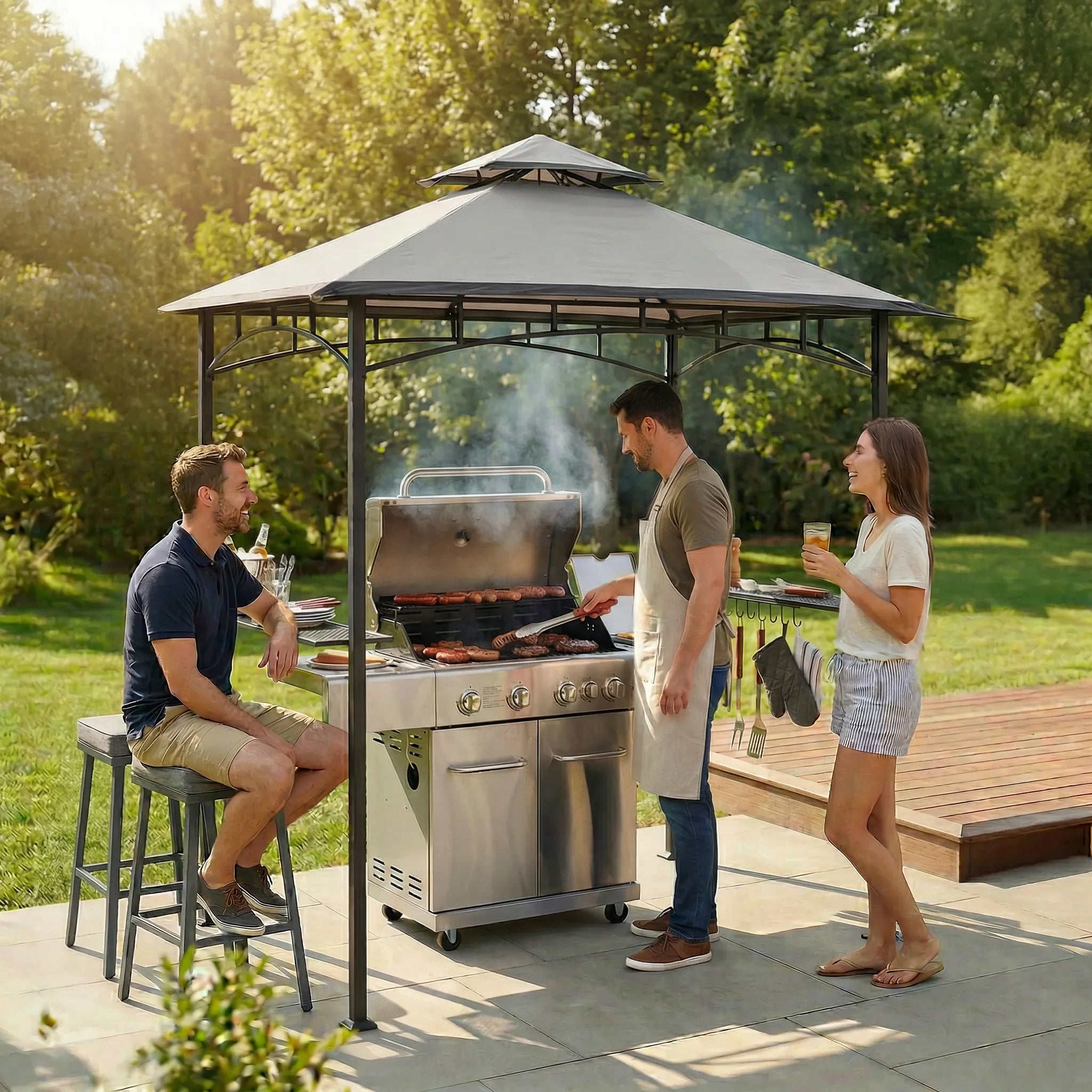
The space-saving case for Sunjoy Outdoor Gazebos: the fit of a poolside or garden setting for compact patios
Families planning a compact patio need to start with the space, not the shelter. SUNJOY outdoor gazebos may appear in several forms, but the suitable direction depends on how people will move, sit, dine, and use the surrounding garden or poolside area. A useful comparison therefore begins with clear measurements and an honest description of the intended activity.

Begin with the space around the gazebo
Sketch the area before browsing individual listings. Mark the patio edge, pool boundary, garden beds, doors, steps, and the paths people use most often. Then note where chairs, a table, a grill, or children’s activities would sit. The goal is not to fill every available inch. It is to understand which footprint leaves the outdoor area practical.
For a compact patio, consider the difference between the shelter’s stated overall size and the usable space around it. A listing may show dimensions, while your real decision also involves entry points and circulation. Leave room for people to approach seating without crossing through the main activity area. If the gazebo is near a pool, keep the route from the house to the water in view. If it is in a garden, consider whether the placement interrupts maintenance access or the view of planted areas.
Use collection categories as a first shortlist
The SUNJOY collection gives shoppers several page-listed ways to sort the starting search. It lists hard-top, soft-top, and wood gazebo categories, and product listings display sizes together with material or roof labels. These labels are useful for narrowing the field, but they do not by themselves decide whether a model suits a particular patio.
A hard-top, soft-top, or wood category can be treated as a comparison route rather than a promise about performance. Start with the way the space is used. A family that wants a defined dining area may focus first on footprint and access. Someone creating a quiet garden corner may place more attention on shape, visual scale, and how the structure relates to nearby planting. Those are planning preferences, not claims about any particular model.
The collection also displays examples described with terms such as cedar, PC-roof, aluminum, solar, poolside, and pergola. For a poolside or garden setting, these labels can help a shopper identify relevant product pages. They should still be read as model or listing descriptions. One example should not be treated as evidence that every gazebo in the collection has the same material, roof, or intended setting.
Compare details that affect a compact-patio decision
When comparing outdoor gazebos, use a small set of questions that keeps the discussion practical. What overall size is listed? What roof type and material are shown? Is the product shape compatible with the patio’s geometry? Do the columns or supports appear likely to affect the usable area? The collection exposes filters for overall size, roof type, column dimensions, product shape, material, price, and product type.
These filters can turn a broad search into a more manageable shortlist. Begin with overall size and shape, because a product that does not fit the available area is not a useful candidate. Next, compare the roof and material labels shown for each model. Then review column dimensions and the product type in relation to furniture placement and movement. Price may also be part of the shopper’s filter, but a displayed price should be considered alongside the features and dimensions of the selected listing.
For a poolside location, map the proposed position against the main walking route and the area used for towels, chairs, or outdoor gatherings. For a garden setting, look at the relationship between the structure, planting beds, and any narrow access route. These checks help reveal conflicts before a shopper becomes focused on a single visual style.
Separate confirmed details from planning assumptions
A collection page can help with discovery, but the selected product page should be the reference point for model-specific details. Treat the collection’s labels as a shortlist tool. Do not assume that a roof category, material name, or setting label applies across the entire range. Exact features can vary by model, so keep a note of the details shown for each candidate.
- Start with the overall size and product shape shown in the collection filters.
- Compare the listed roof type, material, and column dimensions before considering styling.
- Use product type and displayed size labels to narrow the collection without assuming every model has the same features.
- Treat hard-top, soft-top, wood, cedar, PC-roof, aluminum, solar, poolside, and pergola labels as listing or category clues, not collection-wide specifications.
It is also useful to separate three kinds of information in your notes. First, record what the listing states, such as size, roof type, material, shape, or product type. Second, record how the item might fit your patio based on your own measurements. Third, list practical questions about setup, storage, accessories, or furniture placement that are specific to the model. This method keeps a reasonable design preference from becoming an unsupported product claim.
A sensible shopping sequence
Start by measuring the available area and identifying the activities that must remain easy. Use the collection filters to remove options that do not match the required size or general form. Compare the remaining listings by their displayed roof, material, column, and product-type information. Finally, return to the site plan and imagine the furniture, walking route, pool access, or garden work around each candidate.
The collection is not static information that should be treated as a permanent catalogue. Its outdoor gazebo page lists hard-top, soft-top, and wood categories and displays product listings with sizes and material or roof labels, but the live collection can change. Do not rely on a fixed number of models, sizes, or stock when making the shortlist.
For families planning a compact poolside or garden setting, the best approach is a measured comparison rather than a quick choice based on appearance. Use the page-listed filters and labels to organise the search, then judge each candidate against the space and the way people will use it. SUNJOY can be a starting point for that process, provided the selected model’s own details remain the basis for the final decision.