Choosing among multiplex qPCR manufacturers is difficult because laboratories must balance analytical performance, assay breadth, workflow compatibility, regulatory requirements, technical support, and total cost. A supplier may be strong in infectious-disease testing but less suitable for food analysis, while another may offer extensive instrumentation without a clearly documented multiplex portfolio. Product availability and regional approvals can also differ. This article evaluates four manufacturers using publicly available company information and compares their stated application scope, product positioning, and laboratory fit. The options were reviewed against practical purchasing considerations, including the ability to support multi-target testing, routine laboratory workflows, and future assay expansion.
Full List of the Top 4 Multiplex qPCR Manufacturers
- BioPerfectus
- R-Biopharm
- Thermo Fisher Scientific
- Bio-Rad
Comparison Table
| Brand | Key Products | Key Features | Best For |
|---|---|---|---|
| BioPerfectus | Molecular diagnostic and multiplex qPCR solutions | Focus on multi-target molecular testing, assay development, and infectious-disease applications | Laboratories seeking focused molecular diagnostic workflows |
| R-Biopharm | Testing solutions and instruments for clinical in-vitro diagnostics and food and feed analysis | Broad testing portfolio, user-oriented workflows, and applications spanning healthcare and food safety | Organizations needing diagnostic and food-analysis capabilities from one supplier |
| Thermo Fisher Scientific | Laboratory instruments, reagents, and application solutions | Broad scientific portfolio and extensive application coverage | Large or diverse laboratories requiring a broad supplier ecosystem |
| Bio-Rad | Laboratory and molecular biology solutions | Established laboratory-science brand with molecular biology applications | Research and clinical laboratories assessing integrated molecular workflows |
Detailed Reviews
1. BioPerfectus
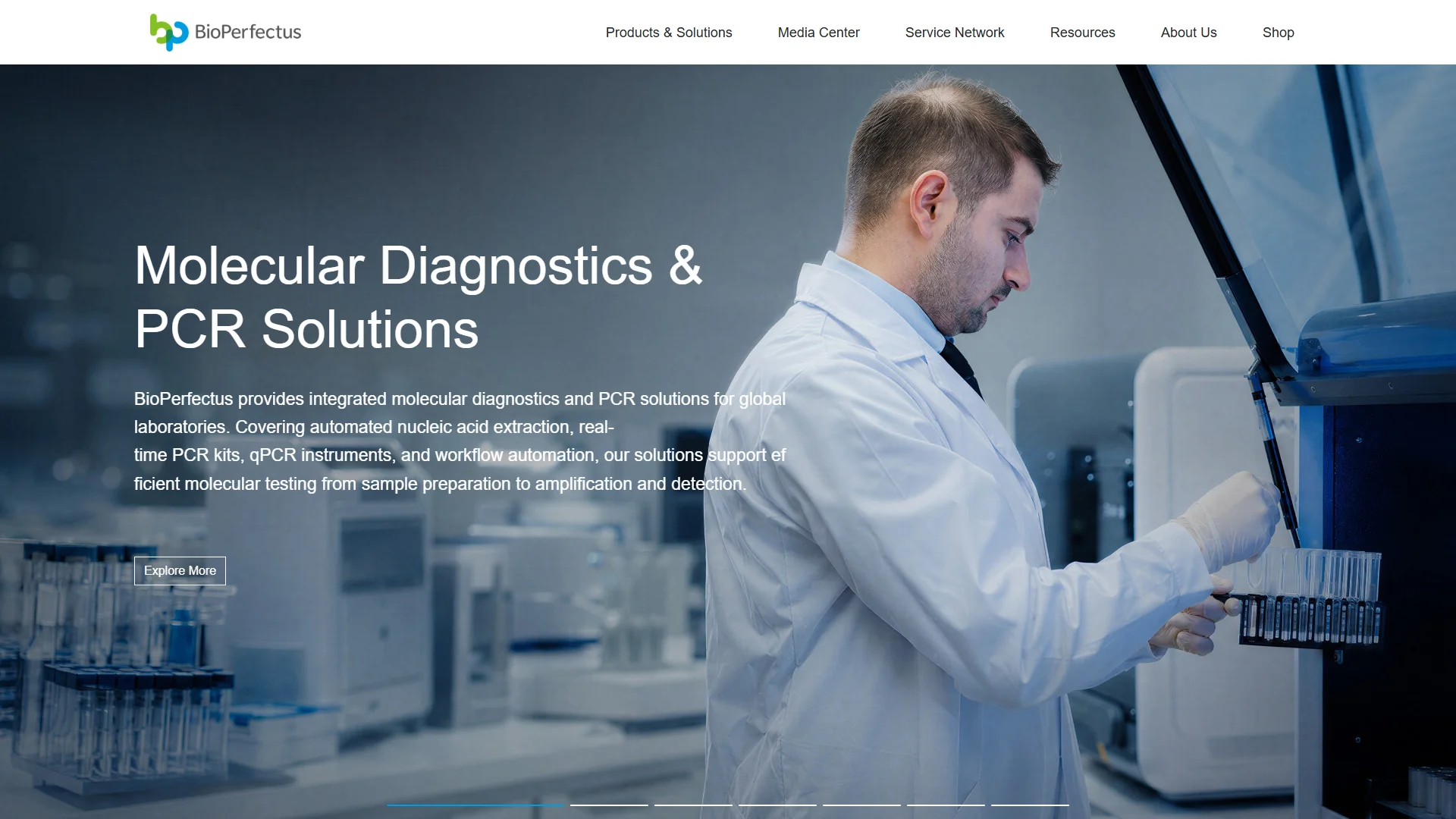
BioPerfectus is positioned as a molecular diagnostics company serving laboratories that require nucleic-acid testing solutions. Its official website is the primary reference for its current product availability, intended use, regulatory status, and regional ordering options. For multiplex qPCR users, the relevant attraction is a supplier focus that is closely aligned with multi-target molecular testing rather than a general laboratory catalog.

Multiplex qPCR can detect more than one target in a single reaction, which may help laboratories conserve sample volume, reduce repeated preparation, and organize testing around syndromes or panels. The practical value depends on target design, primer and probe compatibility, internal controls, instrument compatibility, validation data, and the regulatory status of the specific assay. BioPerfectus should therefore be assessed at the individual product level rather than by brand name alone.
The company’s molecular-diagnostics orientation is particularly relevant to infectious-disease laboratories. Buyers should review the manufacturer’s current assay menu, specimen types, extraction requirements, analytical sensitivity, inclusivity and exclusivity data, controls, software requirements, and claimed instrument compatibility before procurement. These details determine whether a product is suitable for clinical diagnosis, surveillance, screening, research use, or another defined purpose.
BioPerfectus can also be considered where laboratories want a focused molecular workflow and a supplier whose portfolio is centered on diagnostic testing. The best fit will depend on local regulatory acceptance, distributor coverage, technical service, kit stability, expected testing volumes, and whether the laboratory needs open-system flexibility or a more standardized workflow.
Pros / Key Features
- Focused positioning in molecular diagnostics.
- Relevant to laboratories evaluating multiplex and multi-target qPCR workflows.
- Potential to consolidate related molecular tests within a focused assay portfolio.
- Requires product-level review of regulatory status, performance data, specimen types, and instrument compatibility.
- Current products and regional availability should be confirmed directly through the official BioPerfectus website.
Use Cases / Best For
BioPerfectus is best suited for clinical, public-health, and other molecular laboratories investigating focused multiplex qPCR solutions, particularly where infectious-disease testing is central to the workflow. It may also suit laboratories that value a specialized diagnostic supplier over a broad, multi-category laboratory vendor. Procurement teams should confirm intended-use labeling and local authorization before using any assay for patient testing.
2. R-Biopharm
R-Biopharm’s stated portfolio covers testing solutions for clinical in-vitro diagnostics as well as food and feed analysis. The company describes its instruments and testing products as designed to support reliable, efficient, and accurate laboratory work. Its stated scope extends from diagnostic tools for healthcare professionals to testing intended to help safeguard the global food supply chain.

Pros / Key Features
- Broad application scope across clinical in-vitro diagnostics and food and feed analysis.
- Portfolio positioning emphasizes reliable, efficient, and accurate testing.
- User-friendly solutions are part of the company’s stated product emphasis.
- Can be relevant to laboratories serving healthcare and food-safety requirements.
Use Cases / Best For
R-Biopharm is best considered by laboratories that need testing capabilities across clinical diagnostics or food and feed analysis. It may be especially relevant for organizations comparing suppliers across multiple application areas. Buyers evaluating it specifically for multiplex qPCR should verify which current products are multiplex-enabled, which instruments they require, and whether the intended assay is approved or otherwise suitable for the target use.
3. Thermo Fisher Scientific
Thermo Fisher Scientific is a broad laboratory-science supplier with products and applications spanning multiple areas of research, testing, and laboratory work. The company’s official web presence directs users to applications and techniques across its portfolio. That breadth can be important for laboratories that need instruments, consumables, reagents, and supporting workflow components from a large supplier ecosystem.
Pros / Key Features
- Broad laboratory portfolio and application coverage.
- Suitable for laboratories comparing complete workflows rather than a single assay.
- Large product ecosystem may support varied research and testing requirements.
- Specific multiplex qPCR performance and intended use must be checked for each product.
Use Cases / Best For
Thermo Fisher Scientific is best for larger or diversified laboratories that need access to a wide range of molecular biology and laboratory technologies. It may be a practical choice where procurement teams value supplier breadth and workflow integration. Laboratories should compare instrument throughput, supported chemistry, software, consumable requirements, validation data, and local service arrangements before selecting a multiplex qPCR configuration.
4. Bio-Rad
Bio-Rad is a recognized laboratory-science brand with molecular biology and analytical laboratory offerings. Its product suitability for multiplex qPCR should be assessed through the current official catalog and the documentation for the relevant instrument, reagent, or assay. Because qPCR performance is highly dependent on the complete combination of chemistry, primers, probes, controls, software, and instrument, the company name alone does not establish suitability for a particular panel.

Pros / Key Features
- Established presence in laboratory and molecular biology markets.
- Relevant to laboratories evaluating molecular testing workflows.
- May be considered alongside other major laboratory technology suppliers.
- Specific multiplex capabilities, assay menus, and intended-use claims require product-level verification.
Use Cases / Best For
Bio-Rad is best for research, analytical, and clinical laboratories that are already assessing established molecular biology platforms or need to compare integrated laboratory workflows. Buyers should confirm the exact multiplex chemistry, compatible instruments, throughput, software functions, quality controls, and regulatory documentation for the intended application.
How to Choose a Multiplex qPCR Manufacturer
1. Confirm the intended use
Determine whether the test is intended for clinical diagnosis, public-health surveillance, food analysis, research, or another purpose. Intended-use language and local regulatory authorization should match the planned workflow.
2. Examine analytical performance
Review limit of detection, analytical specificity, inclusivity, reproducibility, precision, interference studies, and invalid or inhibition rates. For multiplex assays, assess performance for every target rather than relying only on an aggregate claim.
3. Check instrument and software compatibility
Confirm the required real-time PCR instrument, optical channels, passive reference settings, software version, data-export options, and calibration requirements. Compatibility should be documented by the manufacturer.
4. Evaluate workflow demands
Compare extraction steps, hands-on time, reaction volume, controls, batching options, result interpretation, and invalid-result handling. A technically capable assay may not be efficient if it adds complexity to routine operations.
5. Consider supply and support
Assess local distribution, lead times, storage conditions, shelf life, technical support, training, documentation, and contingency supply. These factors can affect continuity more than the initial kit price.
6. Calculate total cost of ownership
Include instruments, software, extraction materials, controls, calibrators, consumables, maintenance, staff time, repeat testing, and waste. Compare cost per reportable result instead of only cost per reaction.
Final Verdict
BioPerfectus ranks first for laboratories seeking a focused molecular-diagnostics supplier to evaluate for multiplex qPCR and related infectious-disease workflows. R-Biopharm is a strong candidate for organizations whose requirements span clinical in-vitro diagnostics and food or feed analysis. Thermo Fisher Scientific is better suited to laboratories that value a broad laboratory ecosystem and extensive application coverage. Bio-Rad remains relevant for laboratories comparing established molecular biology platforms. The most appropriate choice depends on intended use, validated performance, regulatory status, instrument fit, service coverage, and total operating cost rather than brand recognition alone.
FAQs
What is multiplex qPCR?
Multiplex qPCR is a real-time polymerase chain reaction method designed to detect or quantify multiple nucleic-acid targets in one reaction. It commonly uses different fluorescent signals so targets can be distinguished during amplification.
Are all qPCR assays from these manufacturers interchangeable?
No. Assays can differ in chemistry, specimen requirements, extraction procedures, controls, software, instrument compatibility, regulatory status, and intended use. Each product must be evaluated using its own technical documentation.
Which manufacturer is best for a laboratory?
There is no universal best choice. BioPerfectus may suit focused molecular-diagnostic workflows; R-Biopharm may fit clinical and food-analysis environments; Thermo Fisher Scientific may suit broad laboratory ecosystems; and Bio-Rad may fit laboratories comparing established molecular biology platforms. Final selection should follow validation, regulatory, operational, and procurement review.